



Motion Platform Recommendations
Sigma continually tests and recommends the following platforms for our motion integration. We look at how various factors affect motion response (pitch, roll and heave) and vibrational transfer (fine road and engine vibrations) back to the driver.
Light, rigid and structurally strong rigs excel in our testing for motion feel and translating the full spectrum of vibrations effectively back to the driver. Please note that additional components like seat sliders, seat rails and seats can boost or dampened vibrational transfer. Excessive play in the seat, or seat sliders can also introduce mechanical latency as the driver body tails the feel of the motion.
Driver position is also important or being able to put the driver low down and centered in the rig close to the roll and pitch centers that the mounted actuators create. Ideally we would like to see all four actuators support the mass of the motion platform equally, which typically means having the heaviest part of the rig, the driver, as centered between the 4 actuators as possible. Square or rectangular installations of the actuators do not matter as our software automatically adjusts for various length to width pitch ratios.
Lastly, Newton's 3rd law or every reaction has an opposite and equal reaction matters. So placing your motion platform on hard surfaces can feel overwhelming, and similarly extremely giving surfaces like grass or heavy carpet/rubber matts can dampen motion feel. This is more of a preference and for you to experiment with for your liking.
Edge cases aside, placing the driver low and centered in a rigid and light chassis on a semi-hard surface is often preferred.
Here are the key evaluation metrics we use:
Weight - choose a lightweight chassis possible.
Lighter rigs carry less inertia and allow for change of direction to happen quickly, giving a more responsive feel to the motion. They also allow for finer vibrations like high frequency road textures and engine vibrations come through the chassis better, as they have resistance to motor torque.
Structure - choose a closed off aluminum extrusion platform or fully welded tubular motion platform.
Open ended rigs, with no front brace or support tend to flex or twist as no floor is perfectly even and four actuator motion systems always tend to teeter totter. Repeated flexing or twisting of the platform or frame over time can stress and loosed the connections and introduce unwanted noise and wear. Closed off aluminum extrusion rigs, where the back and the front of the platform is fastened together, perform better in maintaining rigidity. Fully welded tubular rigs are even better at the compromise of higher shipping costs and flexibility.
Balance - choose a platform that allows you to be mounted low and centered in the rig.
Choose a motion platform that is long enough, or allows for the pedal plate to be pushed forward enough to place the driver in the middle of the rig. This allows better actuator placement so that all 4 actuators equally support the dynamic mass. We prefer longer motion platforms, of 50" or longer to allow for better driver placement.
Material - choose lighter materials like aluminum or tubular steel welded chassis platforms.
Material density changes in the way that haptics resonate or transfer throughout the rig. Thick steel structures will feel different and absorb haptics differently than lighter hollow aluminum connected structures. Haptics can be further dampened by things like connectors, seat sliders, seat padding and flooring. These factors all make the chassis "feel different" and are hard to control for overall. So material is worth mentioning, but we always lean towards lean, light structurally rigid motion platforms for the best motion and haptic performance. For one person dedicated rigs we also recommend hard mounting the seat directly to the motion platform.
Here are a few other ways to improve motion feedback and remove mechanical latency:
- Lower your seat as much as possible or use shorter side seat mounts - see our electric slider here
- If you need to use tall side mounts, connect them together with extrusion for lateral support
- If possible, hard mount your seat directly to the extrusion and skip the sliders all together
- Use a fixed or rigid bucket seat with minimal padding - See here why we exclusively run Tillett seats.
- Mount your actuators as close and flush to the chassis/driver as possible without extensions.
- Remove any long extensions or armatures from the chassis.
Please also see our Motion System installation video which universally applies to all motion systems.
Recommended Motion Platforms

Spec: Simulations 282
Weight: Excellent Light and rigid chassis with many accessories to meet your needs. Makes sure to purchase the additional front mounting plate to full enclose your rig structure. (Sigma Spec:) Both the seat and pedal assemblies are versatile and can be mounted very low in the rig. We also recommend the Spec: 282 for most home customers, as the rig is easy to assemble and comes well packaged. Their footwell is ideal for the Sigma Synapse motion controller and prevents EMI with its metal construction. |
|
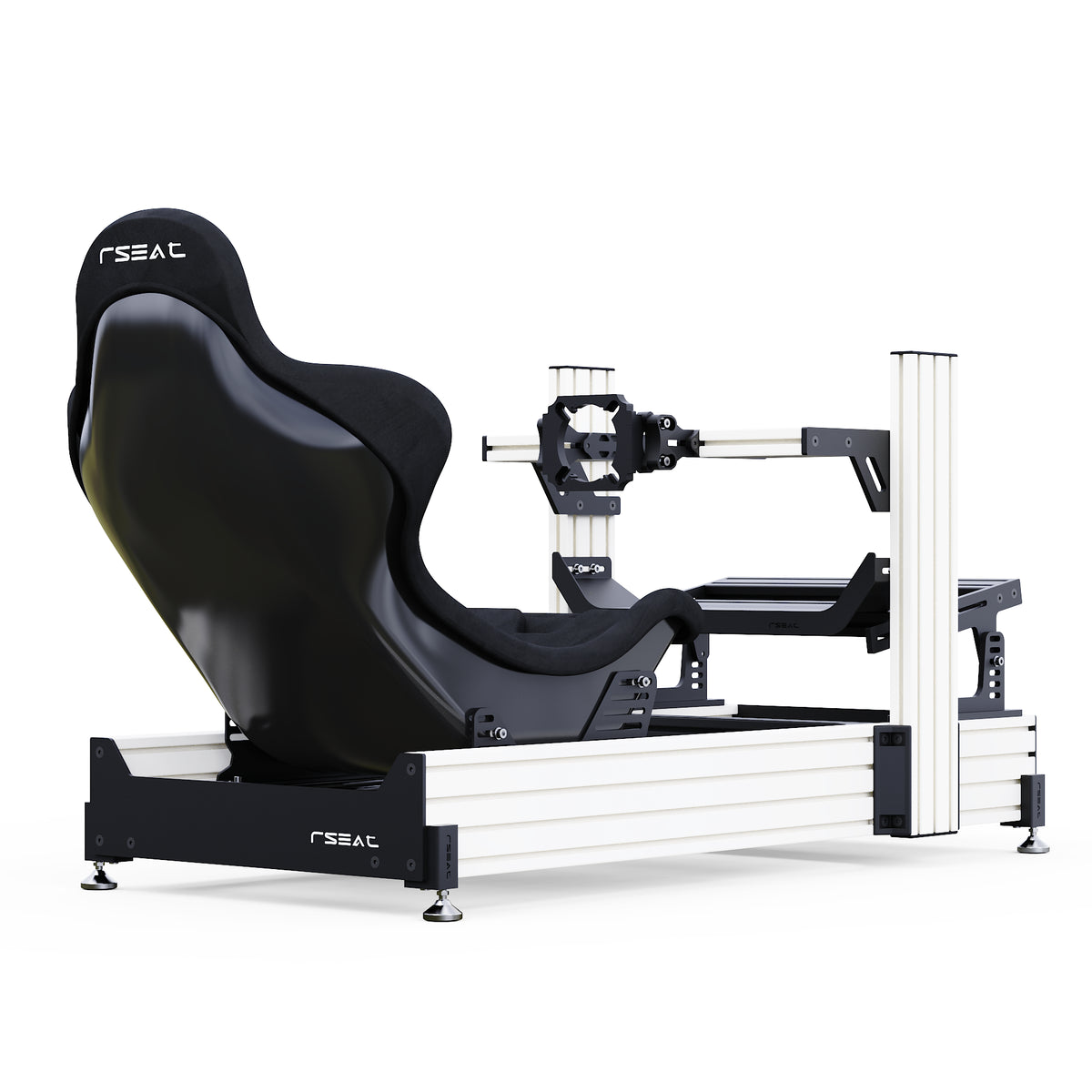
Rseat.com A1 Formula
The rSeat chassis is excellent in rigidity and strength. It also excels in driver placement, putting the driver low and as close to the middle as possible in the formula driving position. The seat is well padded and can absorb more of the fine engine vibrations. The chassis is on the heavy side but a great compromise for the rigidity and driver placement achieved. |
Sim Lab P1X Pro or Ultimate Weight: Great Structure: Good Balance: Good Material: Great The Sim-Lab P1X is a long trusted platform for motion integration. It's stout making it harder for taller drivers to sit more in the middle between the four actuators but its long standing and well supported. We recommend the Ultimate version which allows our actuators to sit higher in the chassis without the extended brackets. Where possible we also suggest placing the driver lower and hard mounting the seat to the chassis. |
If you have a chassis or rig you would like us to test, please suggest it in our socials or email us at info@sigmai.co.
Our motion integrators, turn key builders have used these standards for many years to build optimum setups for their customers. See them here: Sigma Motion Integrators
Page last update: 2026-11-06
Proudly working with